The Agile Business Execution Canvas®
The picture on the box.
ABEC shows, on a single page, how an organisation delivers what its customers value: five pillars, six foundations, and customers at the centre. It works for a whole organisation, a function, a process or a single team.
- Business Model Canvas
- What the business promises: who it serves, what it offers and how it earns.
- Value Proposition Canvas
- Why customers want it: the jobs, pains and gains the proposition must address.
- Agile Business Execution Canvas
- How the organisation keeps that promise: every function and team, joined up at every level.
Business Model Canvas and Value Proposition Canvas: Alexander Osterwalder, Yves Pigneur and Strategyzer. Agile Business Execution Canvas®: Alex McDonnell.
Where it fits
It plugs in. It doesn’t replace.
Alexander Osterwalder and Yves Pigneur’s Business Model Canvas, developed with Strategyzer, describes what a business is. Their Value Proposition Canvas expands its core: what customers need, and how the proposition relieves their pains and creates their gains.
Neither shows how an organisation delivers that fit, again and again. ABEC plugs into both canvases without changing either, following Fritscher and Pigneur’s (2015) recommendation to extend the Business Model Canvas as a plugin rather than alter it.
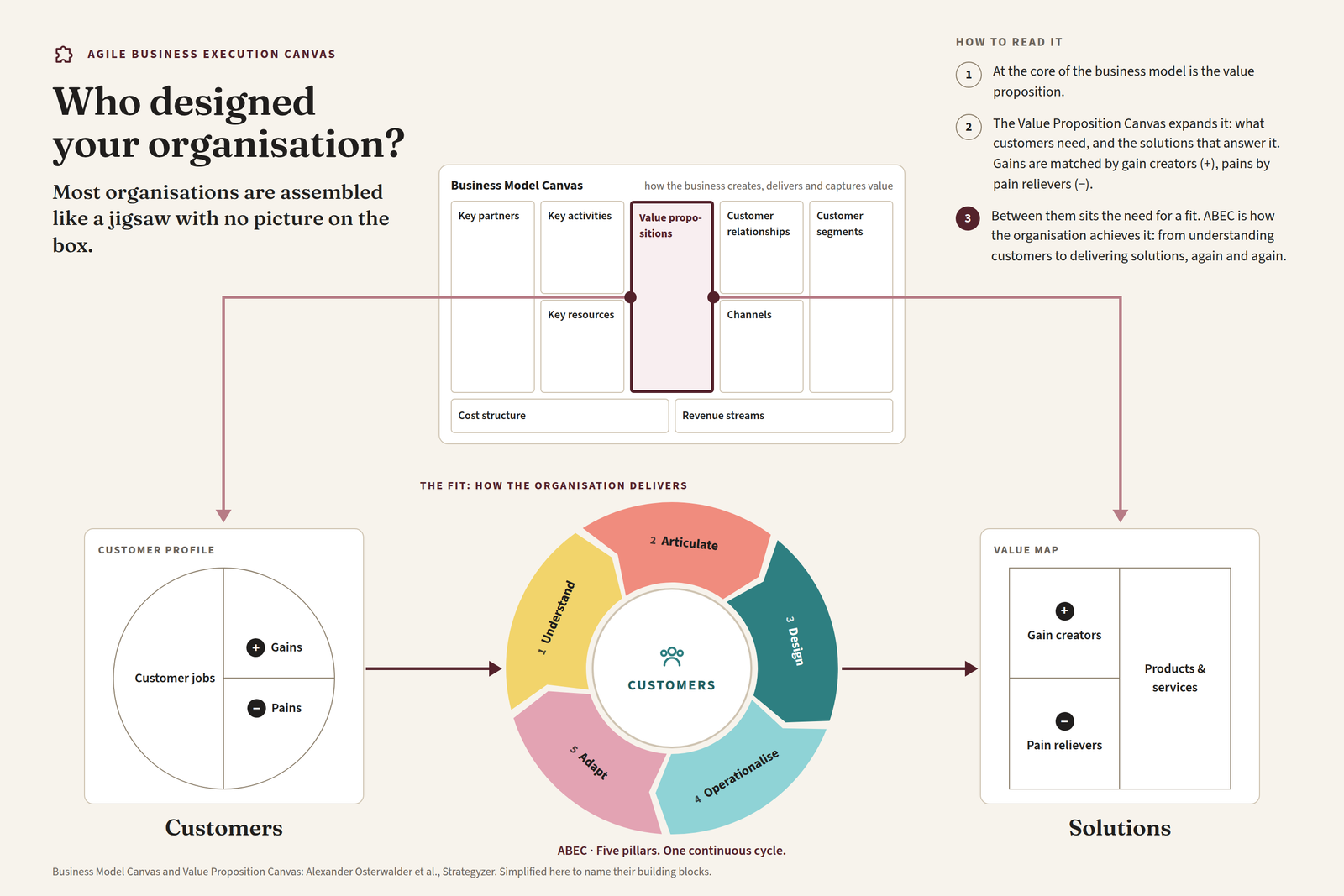
The five pillars
Read left to right. Then round again.
The pillars follow the path from what customers value to an organisation that keeps delivering it. Adapt feeds back into Understand, so the canvas is a cycle, not a one-off plan.
- Must haves
- Must nots
- Delight
- Anticipate
- Internally
- Across
- Externally
- Social system
- Technical system
- Economic system
- Control
- Effectiveness
- Efficiency
- Agility
- Automation & AI
- Digitalisation
- Monitor
- Learn
- Improve
- Respond
- Innovate
01 / Understand
Understand
What customers must have, what they must not get, what would delight them, and what they will need next.
02 / Articulate
Articulate
Making that understanding explicit: internally, across the organisation and to the outside world.
03 / Design
Design
Designing the social, technical and economic system that will deliver it, including which work is done by people and which by automation or AI.
04 / Operationalise
Operationalise
Running it with control, effectiveness, efficiency and agility, with automation, AI and digital technology taking on work under clear human oversight.
05 / Adapt
Adapt
Monitoring, learning, improving, responding and innovating, using data and AI to learn faster, and feeding what is learned back into Understand.
The six foundations
What every pillar rests on.
The pillars only work on solid foundations. Structured Collaboration is the base: the platform everything else runs on.
Platform
Structured Collaboration
The structures and agreements that bring the right people together at the right time, so work flows across boundaries instead of stalling at them.
Direction
Strategy Deployment
Turning strategy into objectives and priorities that every level can act on.
Purpose
Mission / Purpose and Vision
Why the organisation, or team, exists, whom it serves, and what it is working to become.
Conduct
Principles, Values & Behaviours
The rules it designs and decides by, and how people are expected to work with each other and with customers.
Works at every level
The same canvas for a team or the whole business.
A team has customers, internal or external, just as the whole organisation does. It needs the same pillars and foundations. So ABEC applies to a team, a process, a function and the organisation, and the pieces join up.
01 / Best place to start
A team
Serves internal or external customers. Quick to assess, quick to improve, and the building block for everything else.
02 / End to end
A process
Work that flows across several teams, from first request to final delivery, with one owner.
03 / Across boundaries
A function
A department or division, and how it connects to the functions either side of it.
04 / The whole picture
The organisation
The whole business, built up from the teams and processes you’ve already looked at.
Where it came from
Fifty years of practice, tested by research.
ABEC grew out of Alex’s research at the University of Limerick and more than fifty years of building, leading and improving organisations.
It was first set out in The Future of Management Is Not Management. Who Designed Your Organisation? puts it into practice through Concurrent Management: the people responsible for connected parts of the business designing and running it together.
Knowing what we know now, what organisation would we choose to design?
A different starting point
Do not let today’s organisation become the specification for tomorrow’s.
Understand the business as it really works. Define what it genuinely needs to accomplish. Then decide which structures, processes, technologies and roles should be retained, redesigned or replaced, and get those decisions right the first time.
The result
An organisation that works right first time, and keeps working as it grows.
When the right people make connected decisions early, less time goes on rework and workarounds, decisions move faster, and the business can grow without becoming harder to manage. Customers and employees stop running into the gaps between its parts.
The practical tool: your Business User Manual. If an organisation cannot explain clearly, in a few pages, what it does, why it does it and how it works, how can it expect its people to understand it? The Business User Manual is the organisation’s evolving understanding of how the business is intended to work.
It makes clear
How the business is intended to work
- How it creates value
- The capabilities it depends upon
- How teams and functions connect
- How important decisions are made
- How external partners contribute
- How operational learning improves the system
Start the conversation
What would the picture on your box look like?
Take the free diagnostic, or book a 30-minute call with Alex to talk it through.